Fifteen
Years in
the Arena.
From a psychology degree in Riverside to 51 million Americans reached — the full account of how Alex Yarijanian built a career at the intersection of payer strategy, venture building, and population health.

"Healthcare is a system of incentives, contracts, and human decisions. Change the incentives, structure the contracts correctly, and make better decisions — and you can move the system."
Alex Yarijanian
The Foundation
Alex Yarijanian graduated Summa Cum Laude from UC Riverside with a BA in Psychology — a degree that would prove more useful in healthcare than anyone expected. Understanding how people make decisions, how systems shape behavior, and why institutions resist change became the lens through which he would approach every problem that followed.
He went on to earn a Master of Science in Healthcare Administration from California State University, Long Beach, finishing with a 4.0 GPA. The academic record was a signal, but the real education was happening in parallel — in the gap between what healthcare promised and what it actually delivered to the people who needed it most.
Learning the Machine
The early career years were spent inside the machine — learning how payers think, how providers contract, and where the structural misalignments live. Alex worked across payer strategy, network development, and value-based care contracting, accumulating the kind of operational knowledge that only comes from being in the room when deals are made and when they fall apart.
At Humana, he worked on Medicare Advantage directory accuracy — reducing inaccuracy rates by 37.1% across a network that touched millions of beneficiaries. The work was unglamorous and precise. It was also exactly the kind of problem that determines whether a health plan functions or fails at scale.
Founding Carenodes
In 2018, Alex founded Carenodes with a straightforward premise: the populations most underserved by the healthcare system are also the ones most expensive to ignore. The company set out to build digital healthcare delivery infrastructure for exactly those populations — people experiencing homelessness, individuals with Alzheimer's disease, patients seeking OUD treatment, and communities without reliable access to behavioral health services.
Eight years later, Carenodes operates across all 50 states and the District of Columbia. 134 providers under management. 51 million Americans reached. 66,000+ OUD appointments facilitated. The numbers are large, but the work is granular — provider by provider, contract by contract, patient by patient.

The $58M Medicaid Contract
As VP of Payer Strategy at Mahmee, Alex structured a $58 million Medicaid savings contract — one of the largest maternal health value-based agreements in California at the time. The work required translating clinical outcomes into contractual language that payers would sign, and building the operational infrastructure to deliver on what was promised.
The contract became a proof point for what value-based maternal health could look like at scale. It also reinforced a conviction that had been building for years: the gap between what the evidence supports and what gets contracted is almost always a strategy problem, not a clinical one.
Voice & Platform
Alongside the operational work, Alex built a public platform for the ideas he was developing in practice. The Value-Based Care Accelerator podcast ran for 52 episodes — conversations with payer executives, health system leaders, digital health founders, and policy thinkers on what it actually takes to move the industry forward.
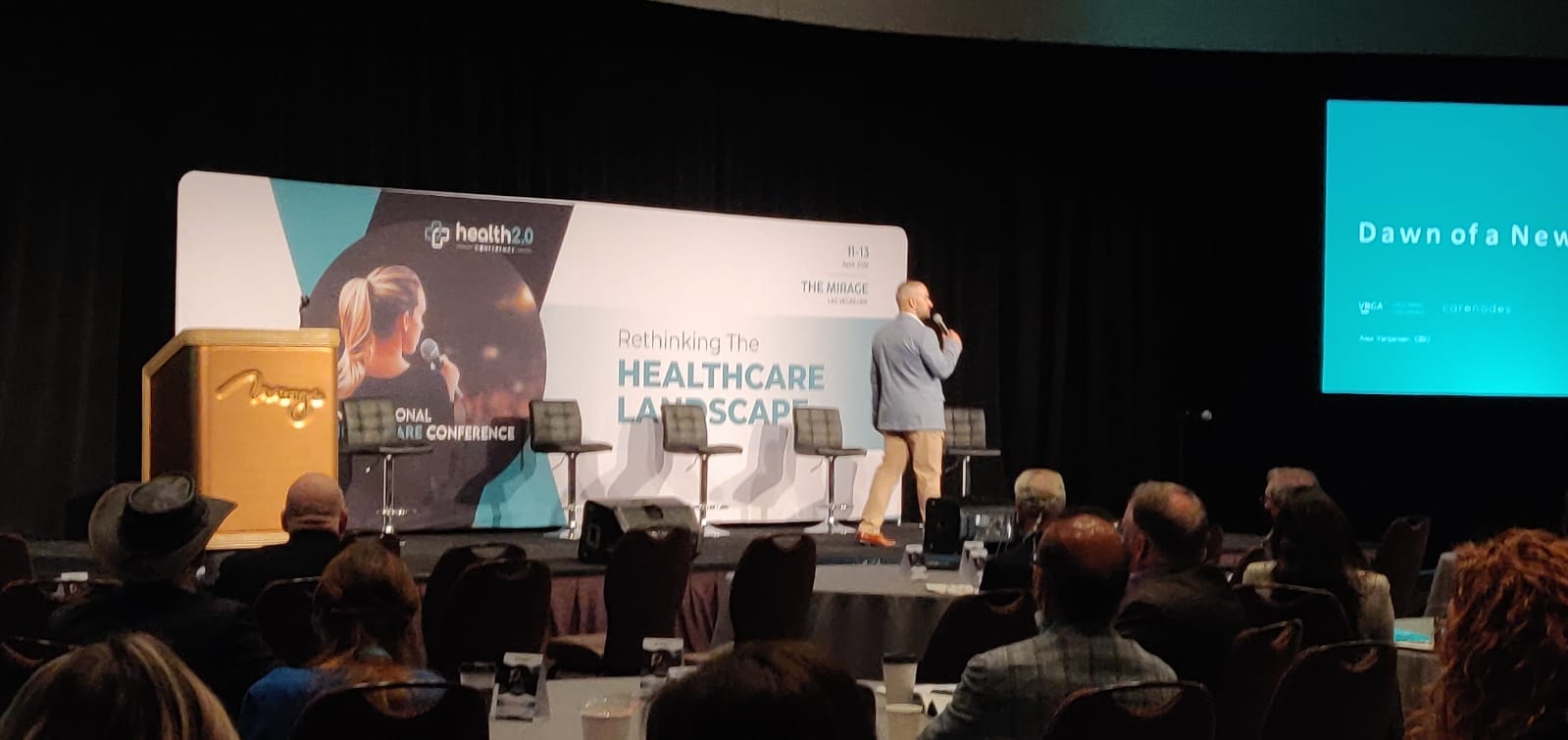
He joined the Forbes Business Council, began contributing to Becker's Hospital Review, and became a recurring presence at Health 2.0, where he received both the Outstanding Leadership Award and the Best Company Award in 2022. The recognition mattered less than the conversations it opened.

The Work Continues
Today, Alex splits his time between leading Carenodes, advising early-stage digital health companies, and speaking at conferences and health systems on payer strategy, population health, and the structural changes that will define the next decade of American healthcare.
The through-line across all of it is the same: healthcare is a system of incentives, contracts, and human decisions. Change the incentives, structure the contracts correctly, and make better decisions — and you can move the system. That's the work. It's slow, it's specific, and it compounds.
Education
- MS Healthcare Administration, CSULB — 4.0 GPA
- BA Psychology, UC Riverside — Summa Cum Laude
Recognition
- Forbes Business Council
- Becker's Hospital Review
- Health 2.0 Outstanding Leadership Award
- Health 2.0 Best Company Award
Impact
- 51M Americans reached
- $58M Medicaid savings structured
- 134 providers under management
- 66K+ OUD appointments facilitated
The work continues.
Let's talk.
Whether you're building a digital health company, navigating a payer contract, or looking for a speaker who's been in the room — I'd welcome the conversation.